Posted on Jan 14th 2008 by trekprops.de.
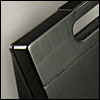
Ah, Starfleet cases. They come in all colors and shapes and I love all of them! Especially the ones that were used by the engineering staff to carry around their great little tools and instruments. But that’s not the only use for them, of course. They’re also very useful to store PADDs for example. And that’s exactly what Captain Picard uses his briefcase for in the TNG-Episode “Starship Mine” (6×18) when he leaves the ship, which is due for a Baryon sweep that requires a complete evacuation. [More…]
Posted on Jan 26th 2007 by trekprops.de.
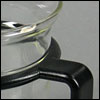 “Tea, Earl Grey, hot!” is one of the most best known phrases of the entire Star Trek universe. Captain Picard usually uses these words to order his favourite beverage from the replicator. And he usually gets the dark liquid in a special type of tea cup, which I have now added to my collection. [More…]
Posted on Feb 17th 2006 by trekprops.de.
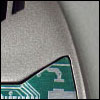 When I got my mobile holo-emitter in an exchange deal, there were some things I didn’t like about it: First off, the curcuit graphic which had been made from a gold foil with the pattern printed green on it was not cut out accurately thus being too small for the intended place. This was especially distracting in the upper right corner of the indentation where the gap was really quite big. Second, the surface of the prop wasn’t really worked up to the degree of a smooth finish I would have liked to have. [More…]
Posted on Feb 17th 2006 by trekprops.de.
One of my favourite characters from “Star Trek: Voyager” is the holographic Doctor. Just as Spock, Data and Odo before him, he as an artificial intelligence represents the outsider among humans, who wishes to be treated with respect and as an equal being. He strives to become more than his original programming and tries to become as human as possible. [More…]
Posted on Jan 27th 2006 by trekprops.de.
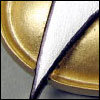 They’re small but powerful – Starfleet Comm badges. They not only decorate uniforms and show that the owner is an officer with the respective training, but they are also full of high-tech.
Once activated, these small devices enable the user to communicate with any other crew memeber who is also equipped with a smiliar badge. While the activation is done by a simple tap, everything else works through a highly sophisticated [More…]
Posted on Jan 17th 2006 by trekprops.de.
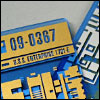 There are props of which I just can’t get enough. One of them are isochips, which are present in the Star Trek universe in many different shapes and colors.
Because of this, I simply had to bid when I saw these chips from the tenth Star Trek movie “Nemesis” on eBay. They are made of shiny blue plexi and feature beautifully laser etched isolinear patterns. These patterns are silver on one and [More…]
Posted on Oct 30th 2005 by trekprops.de.
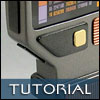 Welcome to the online assembly instructions for my ODN scanner hero kit. In this tutorial, you’ll see how to prepare the electronics for installation and how to insert them into the body. You’ll also learn how to prepare and assemble the hollow resin shells to build up a fully functional hero ODN scanner. First, here’s a pic of the entire kit: 2 resin body parts, electronics, acrylic rod, display graphics, styrene (1.0 mm and 1.5 mm), 2 screws, templates for the styrene details. That’s all you need, so let’s begin! [More…]
Posted on Oct 29th 2005 by trekprops.de.
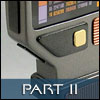 In this second installment of my ODN Scanner progress report I will describe how the finished master model (see Part I) is used to fabricate a silicone rubber mold which then can be used to cast resin kit parts.
Because the finished prop was supposed to contain an electric circuit with a super bright red LED and five green sequencing lights, the mold had to be done in a way so that the [More…]
Posted on Oct 28th 2005 by trekprops.de.
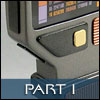 Welcome to the first part of my progress report covering the creation of my ODN Scanner! In this part I will show you how I scratchbuilt the prototype (the so-called master model) of this prop that I will later cast in resin. Part II and the Tutorial will then cover how I did the silicone rubber mold and how to build up one of the resulting kits. [More…]
Posted on Oct 24th 2005 by trekprops.de.
 Chief engineers using their wonderful high tech instruments to diagnose, calibrate and repair circuits and talking “technobabble” – that’s what I love about Star Trek! Geordi LaForge, Miles O’Brien and B’Elanna Torres are some of my favourite characters because they know every system and every technical detail on their ship inside and out – from waste disposal to the warp core. [More…]


